

Growing Up Anglican
By Isaiah Tan
If you already know the words that come after “This is the Word of the Lord” — you might just be Anglican.
I was seven years old when my family moved to St John’s St Margaret’s. We had come from a non-denominational church, and suddenly I found myself reciting the Lord’s Prayer every Sunday. I can’t claim I was the most attentive child (if there were prizes for daydreaming during sermons, I would have been in contention), but looking back, those words were quietly doing their work on my young impressionable mind. Long before I understood what liturgy meant, liturgy was already shaping me.
So what exactly is Anglicanism, and why does it matter?
A Little Bit of Context
Christianity has three major branches: Roman Catholicism, Eastern Orthodoxy, and Protestantism. Anglicanism belongs to the Protestant branch, alongside Baptists, Methodists, Presbyterians, and others.
Despite our differences, Protestants share the Five Solas: Scripture alone, Faith alone, Grace alone, Christ alone, and Glory to God alone. More importantly, all Christians—Catholic, Orthodox, and Protestant—confess the same central truths found in the Nicene and Apostles’ Creeds: that Jesus is fully God, died for our sins, and rose again on the third day. As Paul writes in 1 Corinthians 15, “Christ died for our sins… he was buried… he was raised on the third day.” That is the non-negotiable centre of our faith.
Why do Denominations Exist?
First-tier beliefs define Christianity itself: the Trinity, the death and resurrection of Jesus, and salvation by grace through faith. Disagree here, and we’re talking about different faiths.
Second-tier beliefs include things like baptism, church leadership, and Holy Communion. Christians can disagree on these while still recognising one another as brothers and sisters in Christ, though they may worship in different churches.
Third-tier beliefs are simply preferences: music style, service length… or whether the air-conditioning is just a little too enthusiastic.
Seen this way, denominations aren’t necessarily signs of division. They can actually help preserve unity. Rather than asking everyone to suppress deeply held convictions, denominations allow believers to worship according to their convictions while remaining united around the gospel. Paul warned in Galatians 1 that the gospel itself must never be compromised. But he also acknowledged in 1 Corinthians that not every disagreement warrants a split. At their best, denominations are a loving and practical response to the reality that faithful Christians can arrive at different convictions on important but not salvation-defining issues.
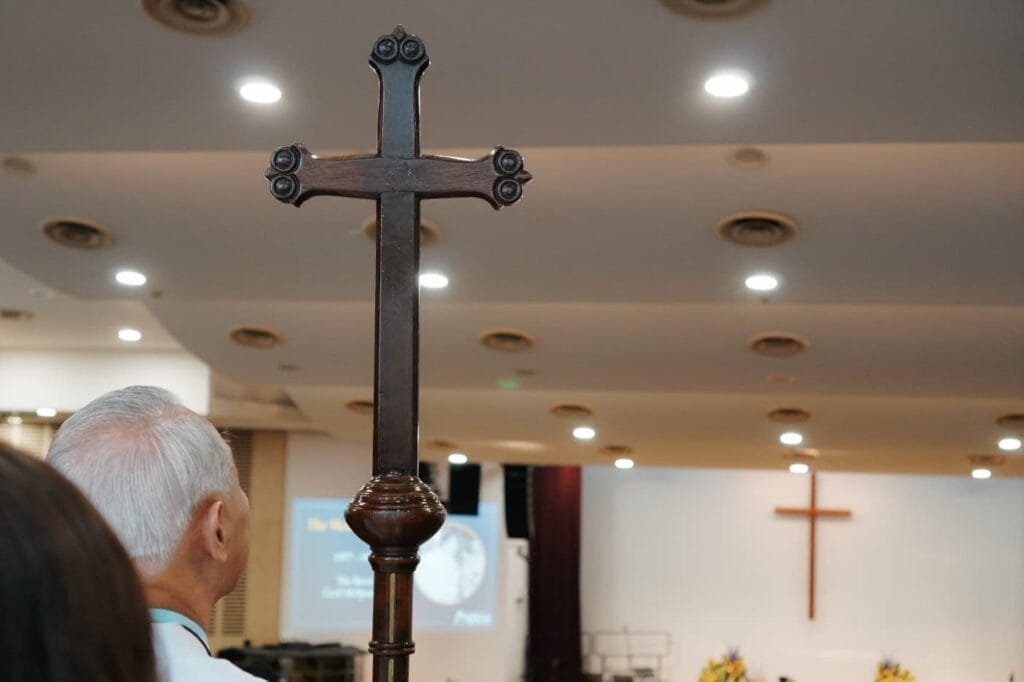
Origin of Anglicanism
Anglicanism traces its roots to the English Reformation of the 16th century. While its beginnings were intertwined with the events surrounding King Henry VIII, it soon became a theological movement shaped by the wider Reformation.
Two documents continue to form its theological backbone.
The Thirty-Nine Articles summarise Anglican doctrine, affirming the authority of Scripture and justification by faith. The Book of Common Prayer gave ordinary Christians a shared language for worship, prayer, and Scripture that continues to shape Anglican life today.
Structurally, the Anglican Church follows a threefold order of bishops, priests, and deacons. Each province is led by an Archbishop, with dioceses overseen by bishops. At the local level, clergy and laity serve together in leadership, reflecting both the priesthood of all believers and the value of historic apostolic order.
Perhaps what I appreciate most about Anglicanism is that it has often been described as the via media, the “middle way.” It treasures the richness and reverence of the historic Church while embracing the Reformation’s commitment to Scripture and salvation by grace through faith. It is both ancient and reforming, both ordered and Spirit-led.
The Beauty and the Danger of Liturgy
A few years ago, I visited a tiny Anglican church in a quiet Australian town. I didn’t know a single person there. The culture was different. The building was different. Even the accents were different. But the moment the service began, something clicked. The familiar rhythm of the liturgy. The same prayers. The same responses. The same confession. I was worshipping alongside complete strangers, yet there was an immediate sense of family. We had almost nothing in common, except the one thing that mattered most. That is one of the gifts of liturgy. It gently interrupts our hurried lives and forms holy habits. It gives us words when we don’t have any, much like a familiar worship song carrying us when our own prayers have run dry. It’s saturated with Scripture, often far more than we realise. And it reminds us that worship isn’t just something we think about; it’s something we participate in. We speak, sing, kneel, stand, confess, receive. Our whole selves are drawn into worship.
Of course, there is also a danger. Pastor Joshua likes to joke that Anglicans are so well-trained that if a barista ever shouted, “This is the Word of the Lord!” across the café, half of us would instinctively reply, “Thanks be to God!” Like any good habit, liturgy can become so familiar that we stop paying attention. Our mouths keep moving while our hearts wander elsewhere. The liturgy was never meant to replace an encounter with God. It was meant to prepare us for one.
A Personal Conviction
Being Anglican is not simply the tradition I inherited. It has become a conviction I hold. The Scripture, the sacraments, the structure, the community. Together they form a rich expression of Christian faith that is grounded in history yet alive to the Spirit. I find in Anglicanism a home that is wide enough to hold mystery, ancient enough to carry weight, and open enough to keep growing.
Whether you’ve worshipped at SJSM for decades or only recently wandered through our doors, my hope is that you’ll discover the same: that Anglicanism is not an end in itself, but a faithful way of helping us know, love, and follow Jesus more deeply.