
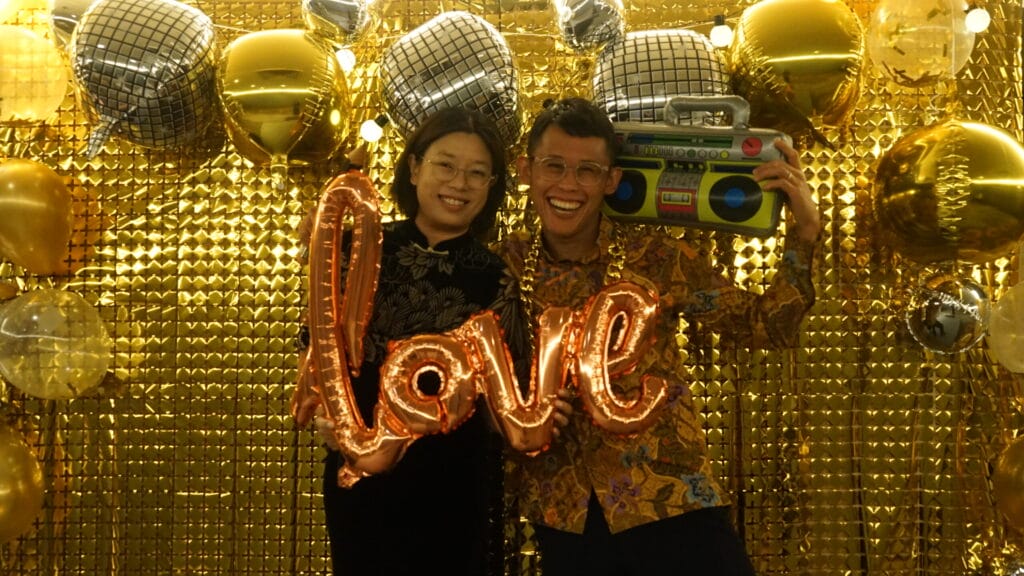
By Zhang Yiwen
When my husband Shen Kiat and I signed up for MER 2025, we carried with us the weight of over a decade together—six years of dating followed by eleven years of marriage that had proven far more challenging than either of us had anticipated. What we discovered over those precious days was not just a renewed vision for our marriage, but a profound reminder of God’s redemptive work in the most intimate corners of our lives.
The Illusion of Knowing
Our love story began in the halls of university, where we met in the Varsity Christian Fellowship. Those undergraduate years were filled with the kind of deep connection that felt unshakeable—serving together in international student ministry, hanging out with our friends and having heart-to-heart conversations in our campus residence. We were convinced that this foundation of friendship and shared faith had given us a deep understanding of each other.
Our confidence was further bolstered by our thorough preparation for marriage. We participated in two separate marriage preparation series, one led by a pastor who had watched me grow from my youth fellowship days, and another guided by an older Christian couple, who had become our mentors. We completed assessments, discussed expectations, and felt equipped for the journey ahead. When we finally married in July 2014, we believed we had done everything right.
Yet nothing could have prepared us for the reality of two sinful people attempting to build a life together under one roof.
The Harsh Reality
The early years of marriage brought a rude awakening. The petty fights and quarrels seemed to multiply with alarming frequency, often over the most mundane aspects of daily life. Household chores became battlegrounds for unspoken expectations about fairness and contribution. Simple failures to communicate personal plans resulted in scheduling conflicts that somehow felt like personal betrayals.
Perhaps most painfully, our expectations surrounding sexual intimacy often led to disappointment and misunderstanding. What we had imagined would be a natural expression of our love became another source of tension, complicated by mismatched desires and unspoken assumptions about pleasure and connection.
These challenges were compounded by external pressures that tested our resilience as a couple. Shen Kiat’s chronic struggles with eczema added yet another source of pain, stress and conflict in our daily lives, and early in his career he faced an existential crisis that shook his sense of identity and purpose as a lawyer. I had my own struggles with feeling overlooked at work and stuck in lack of career progression, despite my heavy workload. During that difficult season, Shen Kiat would often joke—though with an edge of genuine frustration—that the Yiwen he thought he knew before marriage seemed like a completely different person from the one he was living with now. I tried to laugh it off with the excuse that it was because I could truly be myself around him, but his words stung because they contained a kernel of truth that I wasn’t ready to acknowledge.
The Baby Changes Everything
The arrival of our baby, Nathan, brought immense joy, but also intensified the fault lines already present in our marriage. I found myself overwhelmed, feeling as though I was bearing the primary responsibility for both childcare and household management whilst juggling work commitments. The exhaustion was relentless, and my focus naturally shifted towards meeting our child’s immediate needs.
Shen Kiat, meanwhile, felt increasingly disconnected from both me and our marriage. From his perspective, I had become so absorbed in caring for our baby that there was little emotional or physical energy left for nurturing our marriage. Resentment began to brew on both sides—I felt unsupported and overwhelmed, while he felt neglected and pushed aside.
These were dark months for our marriage, characterised by a growing distance that neither of us seemed able to bridge.
A Welcome Pause
It was against this backdrop that we approached MER 2025, desperate for perspective and renewal. The retreat offered something we hadn’t realised we sorely needed—a pause. In the midst of our busy lives, we had forgotten how to simply be together, to listen to God, and to listen to each other.
The retreat created sacred space for us to take stock of our marriage honestly, to acknowledge where we had drifted, and to begin the work of repair and renewal. It was an opportunity to step back from the immediate pressures and conflicts that had been consuming us and to remember why we had chosen each other in the first place.
Remembering God’s Good Design
One of the most powerful aspects of the retreat was being reminded of God’s beautiful design for marriage. We were called back to the biblical vision of marriage as a profound mystery—the husband’s sacrificial love for his wife and the wife’s willing submission to her husband mirroring Christ the bridegroom’s perfect love for his bride, the church.
This wasn’t merely theological theory; it was a transformative lens through which to view our daily struggles. The oneness between husband and wife, we were reminded, reflects the beautiful and perfect unity with our triune God. Our marriage wasn’t just about our personal happiness or compatibility—it was meant to be a living testimony to the gospel itself.
This perspective helped us understand that our conflicts weren’t merely personal failures or incompatibilities. Behind our petty quarrels, there was a larger spiritual battle being waged. Satan’s evil design seeks to destroy the oneness between Christ and his church, and by extension, the oneness between husband and wife. Recognising this spiritual dimension didn’t excuse our sinful responses, but it did help us understand that we were fighting not just against each other, but against forces that sought to undermine God’s good design for our marriage.
Addressing the Unspoken
One of the most valuable sessions focused specifically on sexual intimacy—a topic that, as Pastor Chris Chia noted, is often avoided in Christian circles despite being a source of struggle for many married couples. The session was handled with both sensitivity and biblical honesty, reminding us that as husband and wife, our bodies belong to each other for the sake of our spouse’s godliness.
This wasn’t merely about physical pleasure, but about the deeper spiritual reality that sexual intimacy represents—the complete giving of oneself to another, the vulnerability and trust that mirrors our relationship with God. We were challenged to continue tuning in to each other spiritually, relationally, emotionally, and physically. The session helped us understand that sexual intimacy isn’t separate from our spiritual life together, but an integral part of it.
Holy Ever After
A phrase from the retreat that particularly resonated with us was the concept of “holy ever after.” This reframing helped us understand that marriage isn’t about achieving a state of perpetual happiness or conflict-free existence. Rather, marriage is an ongoing process of sanctification where God shapes us into the image of Christ through the daily challenges and joys of life together.
This perspective was both humbling and encouraging. Humbling because it acknowledged that we would continue to struggle with sin and selfishness throughout our marriage. Encouraging because it reminded us that God is actively working in us, enabling us to will and to work for His good pleasure.
The retreat helped us see that our struggles weren’t evidence of a failed marriage, but opportunities for growth and grace. Every conflict is a chance to practise forgiveness, every disappointment an opportunity to extend grace, every moment of tension a call to choose love over selfishness.

Building Holy Habits for the Long Haul
The biggest takeaway from our retreat experience was the importance of building holy, loving habits as a couple. We committed to establishing daily “couch time”—a dedicated period each day to really listen to each other and pray together with intention. This wasn’t about solving all our problems or always having deep theological discussions, but about maintaining connection with each other amid the demands of daily life.
We also committed to daily doses of love, expressed both in word and action. This meant being intentional about affirmation and appreciation, looking for opportunities to serve each other, and choosing to speak life rather than criticism into our marriage.
**************************
MER 2025 didn’t solve all our problems but it did something perhaps more valuable— it reminded us of the bigger story we’re part of, equipped us with practical tools for growth, and renewed our commitment to the beautiful, messy, challenging and sanctifying work of marriage.